New groups open for autumn: see the start dates

The Resilience Model
Resilience grows with practice.
Resilience may sound like something abstract, but it can be developed in very practical ways. Our Resilience Model shows what children and young people need to grow in resilience, how the different elements connect, and the essential role attention plays throughout. It forms the foundation of the Eline Snel Method and of everything we teach at AMT.
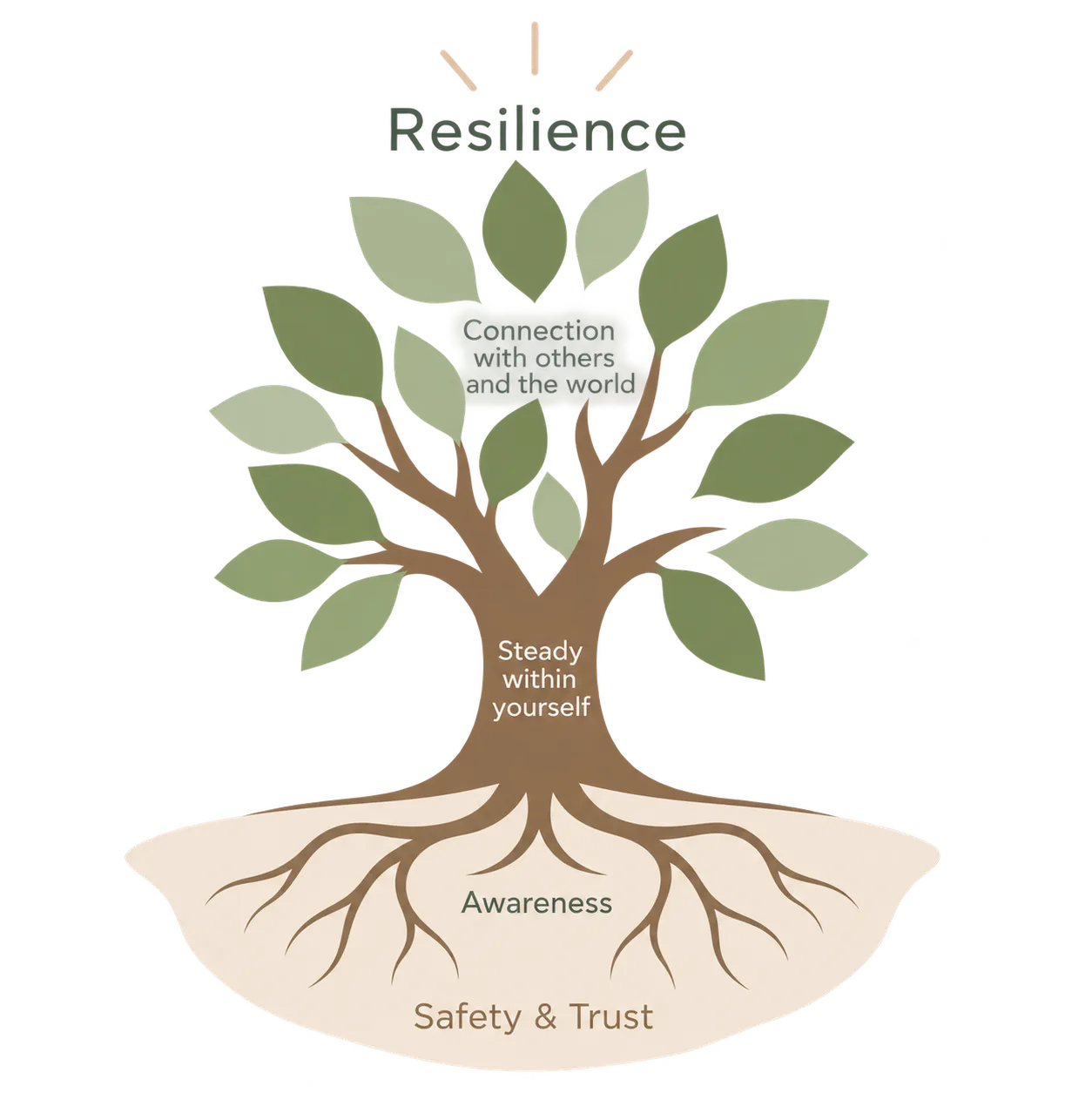
Picture a tree
Four layers. One whole.
A tree needs more than strong branches. It needs nourishing soil, roots that can take hold and a trunk strong enough to carry what grows above. Resilience works in much the same way. Safety and trust create the conditions for growth. Attention takes root. From there, children develop inner strength and, ultimately, a deeper connection with others and the world around them.

The four layers
Resilience grows from what lies beneath.
Each layer supports the next, from safety and trust to connection with others and the world.
The crown
Connected with others and the world
Connection, values and contribution. Growing from a strong connection with yourself towards other people and the wider world.
The trunk
Steady in yourself
Skills, self-confidence, handling setbacks and the power to choose. The qualities that help a child stay grounded when life asks a lot.
The roots
Attention
Learning to notice what is happening in the body, thoughts, feelings and the world around you, without immediately needing to judge, fix or change it.
The soil
Safety & trust
Feeling seen, safe and accepted. The foundation children need in order to explore, learn, make mistakes and grow.
THE TRUNK · STEADY IN YOURSELF
The inner strengths that help a child stay grounded.
From attention grow four building blocks that help children stay close to themselves, even when life is demanding.
“I can do more and more.”
Skills
Directing attention, recognising emotions and learning how to handle difficult situations.
“I trust myself, and I am kind to myself when something goes wrong.”
Self-confidence
Trusting your own abilities while meeting yourself with kindness when things do not work out.
“I can handle difficult moments and find my way back.”
Handling setbacks
Learning to cope with stress and tension and finding your footing again after something difficult.
“I can choose how I respond.”
The power to choose
Recognising the space between what happens and what you do next, and discovering that your response can make a difference.

The crown — with others and the world
From being grounded in yourself to reaching outward.
When children feel more steady in themselves, there is more room for connection with other people and the world around them. These qualities grow not only through attention, but also through relationships, shared experiences and learning together.
“I feel connected.”
Connection
Feeling connected to yourself, to other people and to the world around you.
“I know what matters to me.”
Values
Developing an inner compass and learning to act on what feels important, also in relation to others.
“I can mean something to someone else.”
Contributing
Discovering that what you do matters and that you can contribute to other people and the world around you.
THE THREAD THROUGH EVERYTHING
Attention is where the rest begins.
Attention is not simply one more element in the model. It is the layer from which the other building blocks can grow. It starts very concretely with the body, the breath and the senses. Children learn to notice thoughts and feelings without immediately being carried away by them, to stay with difficult experiences rather than pushing them aside, and to choose more consciously instead of reacting automatically. The aim is not to feel calm all the time. It is to learn how to stay present with what is there.
You cannot stop the waves.
But you can learn to surf.

WHERE IT COMES TO LIFE
The model shows what grows. The method shows how to practise it.
The Resilience Model gives us the bigger picture. The Eline Snel Method turns that picture into practice, helping children develop attention step by step through concrete exercises, stories and experiences. Together, they shape how we train professionals at AMT.

Resilience grows in relationship.
Professionals do more than teach exercises. They help create the environment in which resilience can grow: safe, attentive and connected. Our trainings show you how to bring that into classrooms, practices and groups, so children can practise these skills in the places where they live and learn every day.